The pest plants most likely to take over North Island land are gorse, blackberry, woolly nightshade, tree privet, pampas grass, bamboo, wilding pines, broom and old man's beard. All of them convert usable ground into closed, impenetrable cover within a few years of being left alone. Most are woody enough that mechanical mulching, rather than spraying or hand clearing, is the practical route to getting the land back.
The spiny ones: gorse and blackberry
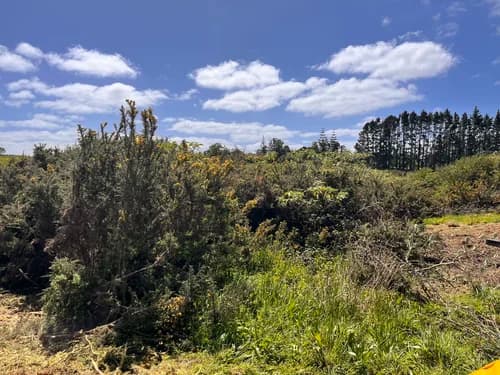
Gorse is the one everybody knows. Dense, spiny, yellow flowered for much of the year, and it drops seed that stays viable in soil for decades. It colonises anything not actively grazed, and on steep faces it goes unmanaged until it is solid. Mature gorse has real woody stems, which is why light equipment struggles with an old stand.
Blackberry is the other spiny colonist, and the more painful one to clear by hand. It layers wherever a cane touches the ground, so it spreads outward from any established clump, and it swallows fence lines, gullies and creek margins fast. Because it roots as it goes, cutting the tops does very little.
The woody invaders: woolly nightshade, tree privet, wilding pines
Woolly nightshade is a fast-growing small tree with large soft grey-green leaves that are felted underneath, purple flowers and clusters of yellow berries. Birds spread it everywhere. It is toxic, the dust from the leaves irritates skin and airways, and it grows into a genuine trunk within a few years.
Tree privet is dense, glossy-leaved and evergreen, with heavy pollen and black berries that birds carry. It forms a closed canopy that shades out everything underneath and it is a common cause of hay-fever complaints. Established privet has a real trunk and needs a machine with the material capacity to take it.
Wilding pines are self-sown conifers, usually contorta, radiata, Douglas fir or larch, growing scattered and irregular where nobody planted them. They convert open country into closed canopy and every year left they get closer to seeding themselves. The economics are simple: a seedling is cheap to deal with, a ten-year-old tree is not.
The grasses and canes: pampas, bamboo, kikuyu
Pampas grass is the tall clumping grass with the feathery plumes, easily confused with native toetoe. It forms huge dense clumps, is a fire hazard, harbours rats and possums, and the leaf edges cut. Spraying a mature clump leaves a dead clump; it still has to be physically removed.
Bamboo is a running grass with woody culms, and running is the problem. It spreads under fences, under driveways and into neighbouring land, and the culms are dense and hard enough to defeat lighter machinery. It is one of the species where material capacity matters most.
Kikuyu is not woody, but it deserves a mention because it smothers everything, climbs fences and needs regular mowing on ground where a ride-on cannot safely go. Kikuyu is a mowing job, not a mulching one, and it is a good example of why the two are different.
The climbers and the rest: old man's beard, broom
Old man's beard is a deciduous climbing vine with fluffy white seed heads in autumn. It climbs into and over trees, smothers the canopy and eventually brings the host down. It is one of the most damaging weeds in native bush margins and it is hard to control once established in a canopy.
Broom is gorse's less spiny relative, a woody shrub with yellow flowers and long thin green stems. It seeds prolifically, colonises the same neglected ground gorse does, and is often found mixed in with it.
What control actually looks like
For almost all of these plants there are three options: herbicide, hand clearing, or mechanical mulching. Spraying is cheapest per hectare and leaves the dead plant standing. Hand clearing is precise and does not scale past a small patch. Mulching takes the whole plant to ground level and processes it into a layer on site, the same day.
The practical question with the woody species is material capacity. Mature gorse, established privet, woolly nightshade with a trunk, bamboo culms and wilding regrowth are all in the 200mm to 300mm range, which is what GRazer's machines are built to take. Lighter slope equipment, typically rated to about 100mm, means either felling everything first as a separate job or declining the site.
GRazer does not spray. Where a species or a situation genuinely calls for it, we will say so. What we do is mechanical clearing on slopes up to 55 degrees, with the operator on stable ground and nothing burned, sprayed or carted away. Biosecurity matters with pest plants, so machines are cleaned between sites and the cleaning is recorded.
The short version
- Gorse, blackberry, woolly nightshade, privet, pampas, bamboo, wilding pines, broom and old man's beard are the usual North Island culprits.
- Most are woody enough that spraying leaves the problem standing.
- Material capacity decides whether an established stand can be mulched in one operation.
- Kikuyu is a mowing job. Everything else on this list is mulching.
- Machines are cleaned between sites, with records kept, so the pest plant does not travel.
Got a site like this?
Call Dan on 027 234 5962, or send the address and a few photos and we will come back to you with an estimate.