
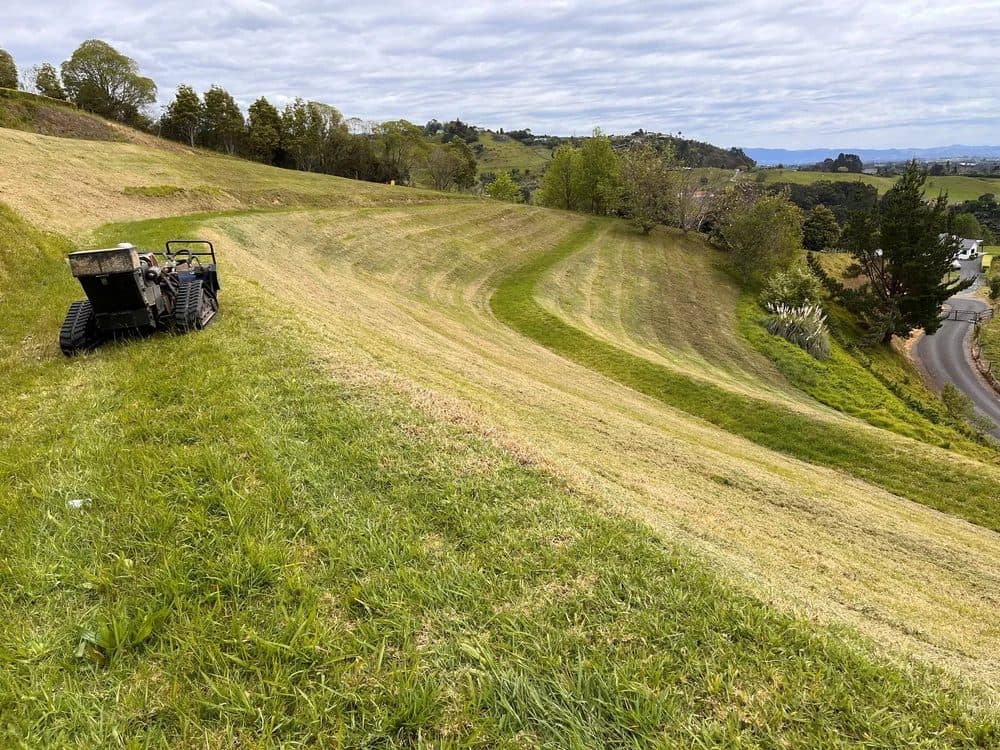
Grass on a steep bank in New Zealand can be mowed with a ride-on to around 15 degrees, a tractor and slope mower to around 20 to 25 degrees, a hand-held scrub bar or brush cutter on foot, or a remote-controlled flail mower rated to 55 degrees with the operator on stable ground. Past about 25 degrees the remote-controlled machine is the only option that keeps a person off the slope. If the growth is woody rather than grass, it is a mulching job, not a mowing one.
First, is it mowing or mulching?
Mowing is grass. Rank pasture, kikuyu, long grass on a reserve bank, a dam wall, a roadside batter that has got away. If the growth is woody, gorse, blackberry, scrub, saplings, it is not a mowing job however steep or flat it is. That is mulching, a different head on a different day.
The distinction matters because the tools are different. A flail mower gives a clean, even, striped finish on soft growth. Put it into mature gorse and it will stall, damage the head or leave a mess. This guide is about grass.
Ride-on mowers: about 15 degrees, and less if it is wet
Most ride-on manufacturers rate their machines to around 15 degrees, and some say less. The practical limit is when the machine starts to slide sideways or the front lifts on the climb. Ride-on rollovers are a common cause of serious injury on lifestyle blocks precisely because the bank at the back looks manageable from the seat.
Wet grass, a dip you did not see, and a turn across the slope are the three things that put a ride-on on its side. If you are already nervous doing it, that is the correct instinct.
Tractor and slope mower: 20 to 25 degrees, honestly
A tractor with a topper or a proper slope mower handles more than a ride-on, and a low, wide, ballasted tractor with a competent operator can work to around 20 to 25 degrees on dry ground. Tractor rollovers remain among the most serious causes of death and injury on New Zealand farms, and most of them happen on slopes the operator had worked before.
There are winch-assisted and tethered tractor set-ups that push the limit higher on some terrain, mostly in forestry. For a farm bank or a council reserve they are rarely practical.
On foot with a scrub bar: any slope, at a cost
A brush cutter or scrub bar works on any slope a person can stand on, which is why it is the default for the awkward bits. The costs are time and safety. A person clears a few hundred square metres of long grass in a day, and steep, uneven, wet ground under long grass is where ankles and knees go. It is fine for a small patch. It does not scale to a bank that is measured in hectares.
Remote-controlled flail mower: up to 55 degrees, nobody on the slope
A remote-controlled flail mower is a tracked machine with no cab. The operator stands on stable ground with a clear view and works the machine on the bank. Because there is nobody on it, the slope limit is set by traction and machine stability rather than by whether the operator survives a roll, which is how the working limit can be as high as 55 degrees. Degrees, not per cent.
GRazer's compact machine, Connie, carries the flail head and gets in from 1.4 metres. She is the machine for reserve banks, stormwater basins, dam walls, roadside batters, kikuyu slopes and the long grass on the bank behind the house. The finish is clean and even, the kind you would expect from a tractor mower on the flat, on ground a tractor should never be on.
The usual pattern is a regular programme rather than a one-off: a slope that is mown on a schedule stays a slope you can see, rather than one that quietly turns into gorse.
The short version
- Grass is mowing. Anything woody is mulching. Different job, different head.
- Ride-ons are honestly limited to about 15 degrees, tractors to about 20 to 25.
- A scrub bar works on any slope but does not scale and is where people get hurt.
- A remote-controlled flail mower works to 55 degrees with the operator on stable ground.
- Steep grass is a maintenance programme, not a single job.
Got a site like this?
Call Dan on 027 234 5962, or send the address and a few photos and we will come back to you with an estimate.