
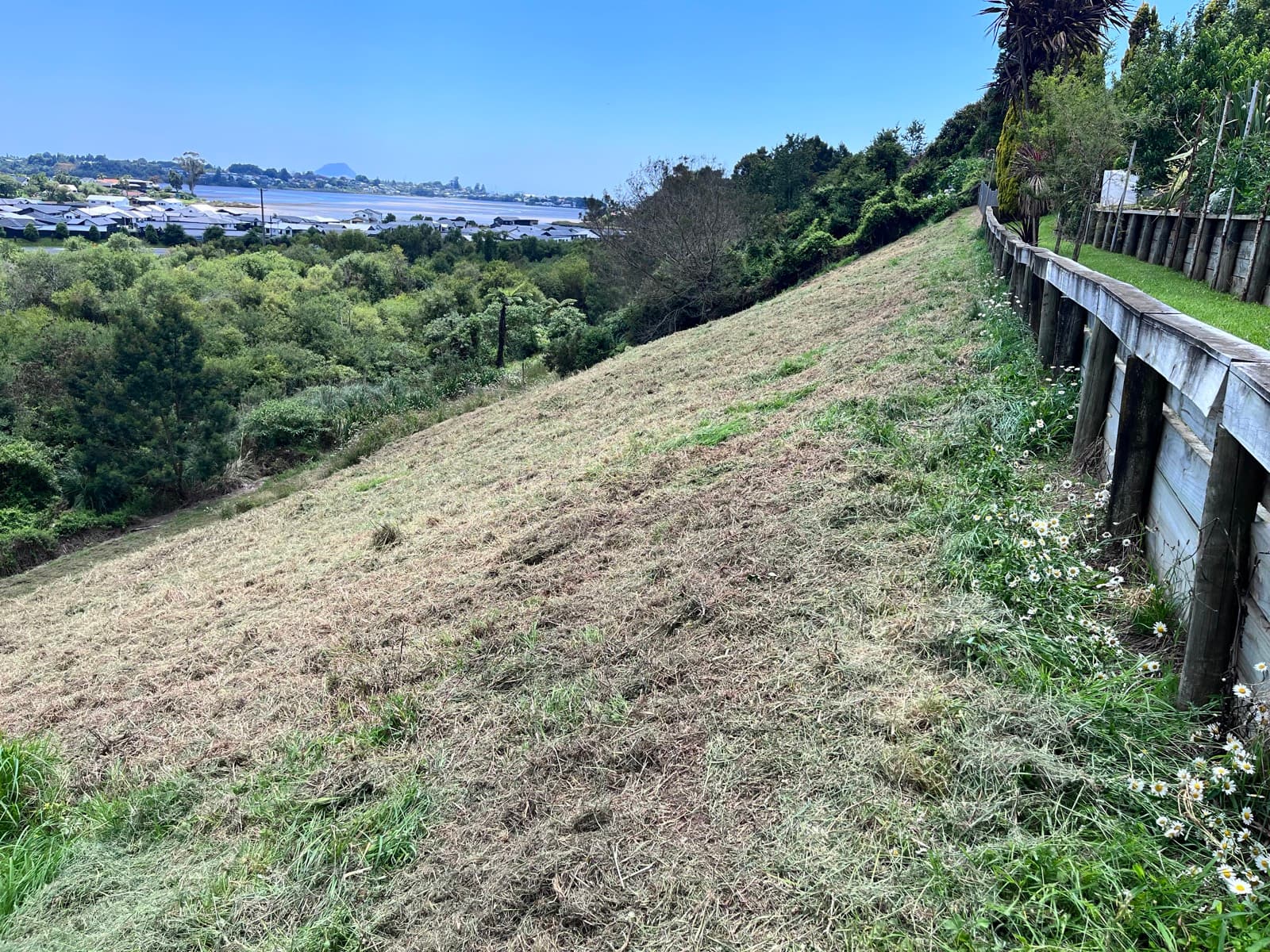
For most lifestyle blocks the best land clearing method is mechanical mulching with a remote-controlled machine: it clears gorse, blackberry and scrub to ground level in a single pass, leaves the material as a mulch layer on site, handles the steep bank and the gully that a tractor or ride-on cannot, and needs no burning, spraying or green-waste disposal. Most blocks are a one-day job, and grazing the regrowth afterwards is the cheapest way to keep it clear.
The bit that got away
Almost every lifestyle block has a part that quietly stopped being used. It is the steep face at the back, the gully down to the creek, or the boundary behind the shed. It got a season ahead, then a year, and now there is no way in without a scrub bar and a bad afternoon. You are paying rates on ground you cannot walk onto, and the gorse or blackberry in there is seeding the rest of the property.
The reason it got away is usually that it is steep, or awkward to reach, or both. A ride-on stops being safe at about 15 degrees. A tractor and topper at about 20 to 25. The gully is below both, which is why it is the gully.
The options, honestly
Spraying it is cheap and leaves a dead version of the same problem standing on the same slope. You still cannot walk into it, and it is now drier and more flammable. Hand clearing it works if the patch is small and flat, and it is a weekend you will not enjoy. Hiring a digger clears it but tears up the ground, needs somewhere for the spoil and material to go, and is not going down a 40 degree bank.
Mechanical mulching takes the whole lot to ground level in one pass and leaves it as a fine layer on the soil. The machine is remote-controlled, so it goes on the face while the operator stays on the flat, and it is rated to slopes of up to 55 degrees. Access is from 1.4 metres, which is why the gully behind a house is possible at all.
What it handles
The question people ask is whether the machine will cope with how far gone it is. GRazer's machines take material in the 200mm to 300mm range, which covers mature gorse with woody stems, established blackberry, privet and woolly nightshade with real trunks, bamboo, and the small trees that come up in a neglected gully. That is the difference between a machine that handles regrowth and one that handles a block that has been left fifteen years.
Nothing is sprayed and nothing is burned, which matters on a lifestyle block. Stock, dogs, kids, a water take, an organic certification or a neighbour ten metres away are all reasons the no-chemical route is the sensible default.
What it typically costs and how long it takes
Most lifestyle block jobs are estimated from the address, a few photos and a description of what is in there, without a site visit. Size is a factor, but density, height, species, slope and access decide the number, which is why a per-hectare rate from a website is not worth much.
As a rule of thumb, most blocks are a one-day job. A single gully or bank is often less. The heavy-duty machine covers typically 2 to 3 acres a day on open ground, and steep or dense ground is slower. You do not need to be home while the work is done, as long as access is clear.
Keeping it clear
Mulching does not remove the seed bank, nothing does, so the plan has to include what happens after. The cheapest answer on a lifestyle block is stock. Regrowth through a mulch layer is soft and short and animals will keep it down, and grazing only becomes possible once the face is cleared.
Where you cannot graze it, a light follow-up pass a season or two later deals with regrowth at a fraction of the original cost. A block that is looked at every couple of seasons stays clear cheaply. The expensive version is the one where it gets left another decade.
The short version
- The overgrown bit is usually the steep bit, which is why conventional gear never dealt with it.
- Mulching clears it to ground level in one pass, on slopes up to 55 degrees, with access from 1.4 metres.
- No chemicals, no burning, no green waste, which matters with stock, kids and neighbours.
- Most blocks are a one-day job, estimated from photos and the address.
- Graze the regrowth. That is the cheapest maintenance there is.
Got a site like this?
Call Dan on 027 234 5962, or send the address and a few photos and we will come back to you with an estimate.