Cost guide
What forestry mulching costs, and what moves the number
Material size is the constraint that decides whether it is a mulching job at all.
The honest answer
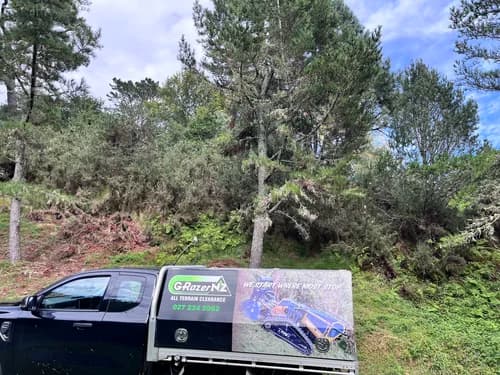
Forestry mulching is priced on how much material has to be processed and how hard the ground is to work, not on area alone. The threshold question is material size: GRazer process material up to 200mm to 300mm, which is well beyond typical slope mulching capacity in New Zealand, but past that it becomes a different kind of operation and they will say so. GRazer estimate most jobs from Google Maps, photos and the property address, which means you can get an initial number without anyone driving out. For larger, more complex or high-value projects they may recommend a site visit to confirm scope before work starts.
What actually drives the number
Material size
The first thing to establish. Up to 200mm to 300mm is within capacity. Beyond that you are looking at a felling operation with mulching afterwards, which is a different scope and a different cost.
Stem density
How many stems per hectare determines how much material the machine actually has to process. A sparse wilding spread across a face is very different from a closed regrowth block of the same area.
Terrain
Plantation and wilding country is steep by definition. Workable to 55 degrees, with the operator off the face, but gradient affects the rate of work.
Access and travel
Forestry blocks are often remote with limited or seasonal access. Getting the machine in, and the state of the access tracks, factors in.
Finish required
Knocking undergrowth down for access is faster than processing everything to a fine even layer for replanting.
How to keep the cost down
- Deal with wilding spread early, the cost curve on conifers is brutal
- Combine adjacent blocks or coordinate with neighbours into one mobilisation
- Be clear whether you need access or a planting-ready finish
- Confirm material size up front so the right scope is quoted
- Schedule around dry conditions where the access tracks allow it
What is included that is easy to miss
- Material processed into the ground layer on site, no extraction, no cartage
- No burning, so no permit and no fire risk
- Remote operation on slopes to 55 degrees
- Prequalified for forestry health and safety requirements
Cost questions we get asked
What if some of the trees are too big?
Is it cheaper than felling and extracting?
Other cost guides
- Land Clearing Cost in NZThe honest version: area matters less than people think, and access matters more.
- Gorse Removal CostAge of the stand is the biggest single driver, and the one you can still do something about.
- Slope Mowing CostThe cheapest slope mowing is the kind that happens regularly. Rescue jobs cost more.
- Section Clearing CostThe big saving is not the clearing rate. It is not paying to truck the material away.

Want a number for your place?
Send the property address and a few photos, including the access. Most estimates come back without a site visit.