Comparison guide
Mulching or spraying: which one actually gives you the land back
The most common question we get. Both have a place, and the difference is simpler than it looks.
The short answer
Spraying kills the plant. Mulching removes it. If what you want is access (to walk it, graze it, fence it, build on it or see it) mulching gives you that on the day, and spraying does not, because a dead plant is still standing exactly where it was. If what you want is long-term suppression of regrowth across a large area and you can live with dead material standing for a season or two, spraying is cheaper per hectare.
Side by side
| Spraying | Mulching | |
|---|---|---|
| What it leaves | Standing dead vegetation | A fine mulch layer on the ground |
| Access afterwards | Unchanged until it breaks down | Immediate |
| Time to visible result | Weeks, then years to break down | Same day |
| Fire risk | Increases, dead material is drier | Reduces, fuel is processed |
| Chemical on your land | Yes | None |
| Effect on the seed bank | None | None |
| Cost per hectare | Lower | Higher |
Spraying
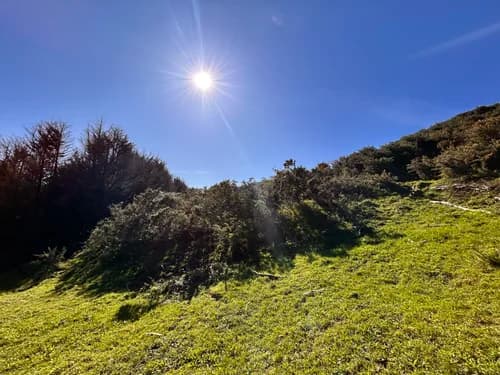
Herbicide is a legitimate and widely used tool, and for broad-scale suppression on country you do not need to physically use, it is hard to beat on cost. The honest limitation is that it does not remove anything. A sprayed gorse face is a face of dead gorse: drier, more flammable, still impenetrable, and still blocking every metre of ground underneath. On steep country it can stand for years.
Mulching
We mulch the vegetation in place and process it into a fine layer that stays on site. You get access back the same day, the fuel load goes down rather than up, and there is no chemical involved at all, which matters if you have stock, a water take, an organic certification or neighbours. Neither method touches the seed bank in the soil, so regrowth expectations are the same for both.
When the other option is the right call
Spraying wins on large areas of country where access is not the point and budget per hectare is the binding constraint, and for spot treatment of scattered regrowth after a clearing job. GRazer does not spray, so if that is what your situation calls for, we will say so rather than talk you into a mulching job.
Other comparisons
- Mulcher Hire vs Hiring an OperatorThe most-searched question in this category. Worth answering honestly, including the part where hiring is the right call.
- Mulching vs BurningBurning is the traditional answer and it is getting harder to do. Here is the practical comparison.
- Mulching vs Excavator ClearingAn excavator is the usual first thought. It is often the wrong tool for vegetation specifically.
- Mulching vs a Hand CrewA hand crew looks cheaper per hour and rarely is per hectare. Safety is the bigger difference.
- Mulching vs a Tractor and MowerMost farms already have a tractor. This is about the ground it cannot safely go on.
- Chipping vs MulchingPeople often use the words interchangeably. They are quite different jobs.
- Mulching vs MowingThe most useful distinction on this site, and the one people most often get wrong when they call.
What you are dealing with
- GorseThe big one. Dense, spiny, seeds for decades, and it takes hold on exactly the slopes a tractor cannot work.
- BlackberryLow, dense, thorny and endlessly persistent. The classic gully and fence-line invader.
- Woolly nightshadeFast, tall, toxic to handle, and a declared pest plant across most of the North Island. Second only to gorse for search interest.
Want a straight answer for your site?
Send the address and a few photos. If mulching is not the right answer for what you have, we will say so.