Comparison guide
Mulching or a hand crew: what you are really comparing
A hand crew looks cheaper per hour and rarely is per hectare. Safety is the bigger difference.
The short answer
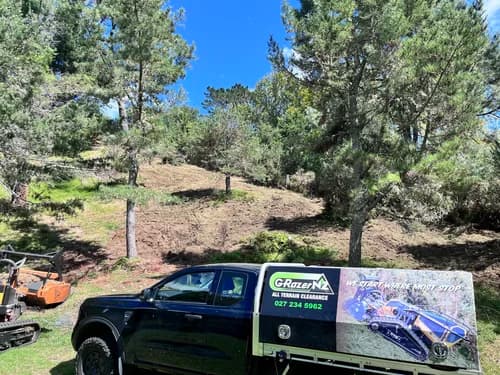
For anything beyond a small area, mechanical mulching wins on cost per hectare, time and safety. A hand crew wins where the site is genuinely too tight or too sensitive for a machine, or where selective removal matters more than speed. The safety difference on steep ground is not a close call: our operators are not on the slope at all.
Side by side
| Hand crew | Mechanical mulching | |
|---|---|---|
| Rate of work | Slow across area | Typically 2 to 3 acres a day on open ground |
| Cost per hectare | High once the area grows | Lower at scale |
| Who is on the slope | People, with cutting tools | Nobody |
| Material handling | Cut material must be heaped, burned or carted | Mulched in place |
| Selectivity | High, can work around individual plants | Good, but not plant by plant |
| Weather dependence | High | Prefers one to two dry days |
Hand crew
Hand clearing is precise and it can go where machines cannot. On a tight site, among established plantings, or where you need specific plants left standing, a good crew with scrub bars and chainsaws is the right answer. The costs are that it is slow over area, the cut material still has to be dealt with afterwards, and on steep, spiny or toxic vegetation you are asking people to spend days in genuinely unpleasant and hazardous conditions.
Mechanical mulching
Mechanical mulching covers ground quickly, deals with the material in the same pass, and keeps people off the slope entirely. On gorse, woolly nightshade and blackberry that last point matters a lot, those are species where hand clearing means spines, toxic irritant hairs and thorns for days at a time. Our machines get in from 1.4m width and work to 55 degrees, so the definition of "too tight or too steep for a machine" is narrower than it used to be.
When the other option is the right call
Small areas, tight sites, and anywhere selective removal is the whole point, restoration plantings, established gardens, working around specific trees. Some of our jobs are a machine pass followed by a hand crew doing the fine work, which is often the most sensible combination.
Other comparisons
- Mulcher Hire vs Hiring an OperatorThe most-searched question in this category. Worth answering honestly, including the part where hiring is the right call.
- Mulching vs SprayingThe most common question we get. Both have a place, and the difference is simpler than it looks.
- Mulching vs BurningBurning is the traditional answer and it is getting harder to do. Here is the practical comparison.
- Mulching vs Excavator ClearingAn excavator is the usual first thought. It is often the wrong tool for vegetation specifically.
- Mulching vs a Tractor and MowerMost farms already have a tractor. This is about the ground it cannot safely go on.
- Chipping vs MulchingPeople often use the words interchangeably. They are quite different jobs.
- Mulching vs MowingThe most useful distinction on this site, and the one people most often get wrong when they call.
What you are dealing with
- GorseThe big one. Dense, spiny, seeds for decades, and it takes hold on exactly the slopes a tractor cannot work.
- Woolly nightshadeFast, tall, toxic to handle, and a declared pest plant across most of the North Island. Second only to gorse for search interest.
- BlackberryLow, dense, thorny and endlessly persistent. The classic gully and fence-line invader.
Want a straight answer for your site?
Send the address and a few photos. If mulching is not the right answer for what you have, we will say so.