
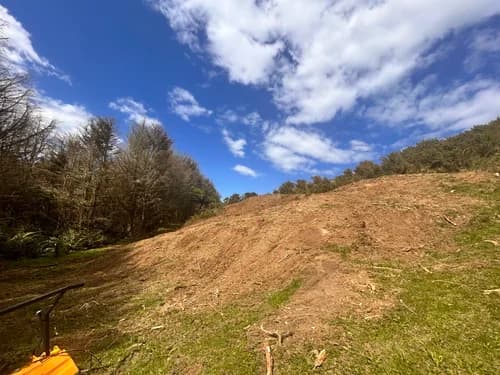
Land lost to gorse, blackberry or scrub is reclaimed for grazing by mulching the vegetation to ground level, leaving the material as a layer on the soil, fencing the block so it can be stocked, and then grazing the regrowth hard while it is soft. Mulching rather than spraying or burning gives you access the same day, keeps the soil covered and stable, and puts no chemical on ground that stock will be on. The grazing itself then becomes the cheapest weed control available.
How a paddock becomes a gorse block
It is rarely a decision. A steep or awkward paddock gets lightly stocked, then rested, then skipped a season because the fence needs work, and the gorse or broom that was always there in the corner takes the gap. Within a few years it is solid and the paddock is off the map. Meanwhile it is seeding every paddock downwind and you are paying rates on it.
The thing to hold onto is that the ground has not changed. The soil, the aspect, the contour that made it a paddock are all still there under the gorse. Reclaiming it is a clearing job and a management plan, not a miracle.
Clearing it: why not spray or burn
Spraying kills the stand and leaves it standing. You still cannot get stock in, the dead material is a fire risk, and on a slope it can stand for years. Burning has its place in some country and is weather dependent, regulated, and leaves bare, unstable ground on a slope that will erode before it grasses.
Mulching takes the vegetation to ground level and processes it into a fine layer over the soil, in one pass, the same day. The old root systems stay in the ground holding the slope, the layer covers the soil, and there is no chemical on ground that stock will be grazing. GRazer's machines take mature gorse and scrub in the 200mm to 300mm range and work slopes up to 55 degrees, which covers most of the paddocks that got away precisely because they were steep.
The mulch layer is an asset, not a problem
People sometimes worry that a layer of chipped gorse will stop grass. In practice the layer breaks down into the soil, suppresses regrowth by cutting light to the surface, and holds moisture on a face that would otherwise dry out. Grass comes through it, and the regrowth that comes with it is soft, short and exactly what stock want to eat.
The alternative, bare cleared ground, is worse on every count: it erodes, it dries, and the seed bank germinates in full sun with nothing to slow it down.
Fence it, then stock it hard
The first thing a cleared block needs is a fence that holds stock, which is often the job that was deferred in the first place. With the vegetation gone the fence line is accessible and the work is straightforward.
Then graze the regrowth while it is soft. Cattle and goats in particular will take gorse and broom regrowth readily when it is young, and sheep will keep a mulched face tidy. The aim is to never let the regrowth get woody. A block grazed on rotation from the first season stays a paddock. A block cleared and left is a gorse block again in five years.
Realistic expectations
Nothing removes the seed bank. Gorse seed stays viable for decades and an established stand has been dropping it the whole time. Regrowth will come. The difference after mulching is that it comes through a layer, it is soft, you can see it, and stock can reach it. That is what makes grazing work as control.
Where grazing cannot carry the load alone, a light follow-up pass a season or two after clearing deals with anything getting away, at a fraction of the original cost because everything is small. Budget for the fence and for that possible second pass, and the reclaimed paddock is a genuinely cheap asset to keep.
The short version
- The ground under a gorse block is still a paddock. Reclaiming it is clearing plus management.
- Mulching gives access the same day with no chemical on ground stock will graze.
- The mulch layer covers and stabilises the soil and slows regrowth. Bare ground does the opposite.
- Fence it, then graze the regrowth hard while it is soft.
- Plan for the seed bank: rotation grazing and possibly one light follow-up pass.
Got a site like this?
Call Dan on 027 234 5962, or send the address and a few photos and we will come back to you with an estimate.