
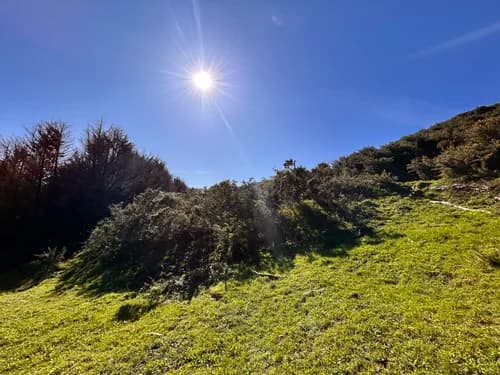
Slope mulching is the mechanical clearing of vegetation on steep ground using a remote-controlled machine. The operator stands on stable ground while the machine works the face, cutting the vegetation to ground level and processing it into a fine mulch layer that stays on site. It handles gorse, blackberry, scrub and small trees on slopes up to 55 degrees, with no chemicals, no burning and nothing carted away.
Step one: the estimate, usually without a site visit
Most slope mulching jobs are priced from the address, a few photos and a description of the vegetation, using Google Maps to check the area, the gradient and the access. Property size is a factor, but density, height, what species is in there, and how the machine gets to the face matter just as much.
For larger, more complex or high-value work a site visit is recommended before pricing, so the scope is confirmed and there are no surprises. Either way, the aim is an honest number before the machine is loaded, not a revised one on the day.
Step two: access and conditions
The compact machine gets in from as little as 1.4 metres of entry width, which is why so many gully, boundary and back-of-section jobs are possible at all. Where access is genuinely impossible, alternative arrangements can usually be made, but that is a conversation at the estimate stage.
Weather matters. One to two dry days are preferred for site access, safety and productivity. Ground moisture affects traction on a face, and a wet slope is where a good operator says no for the day rather than pushing on.
Step three: what happens on the face
The machine is walked to the base or top of the slope and the operator finds a position on stable ground with a clear view of the whole face. From there the machine works the slope in passes, generally across the contour and then down, so the mulch layer is spread evenly rather than piled.
The mulching head takes the vegetation at ground level. On thick, tall material such as mature gorse or bamboo at 200mm to 300mm, the head will cut it down, flatten it and then mulch it in a few passes. Everything is processed where it stands. There is no cut-and-drag, no piling and no burn pile.
Work rate on open, accessible ground is typically 2 to 3 acres a day for the heavy-duty machine. Steep, dense or awkward sites are slower, which is why the estimate is built from the site rather than from a flat per-hectare rate.
Step four: what the ground looks like afterwards
A cleared face is covered in a layer of fine chipped material sitting on the soil surface. It looks like a bark garden bed, brown and even, with the old stems and roots left in the ground. That mulch layer does two useful things: it suppresses regrowth by cutting light to the soil, and it breaks down into the soil rather than being removed.
The finish is deliberately not bare earth. Scalping a slope to soil is how you get erosion, and the whole point of processing the material in place is to leave the face stable. Under normal conditions there is light surface tracking from the machine and not much else.
You get access back the same day. That is the practical difference from spraying: you can walk the face, run a fence, check the boundary or put stock on it straight away.
Step five: regrowth and follow-up
Mulching does not spread seed. The process crushes vegetation and creates a layer that limits germination. Where regrowth does appear it comes from the seed bank that was already in the soil, and for species like gorse that bank can be decades deep.
The cheapest follow-up is grazing, which only becomes possible after the face is cleared. Where grazing is not an option, a light second pass a season or two later deals with soft regrowth at a fraction of the original cost. Either way, a slope that is checked every couple of seasons stays clear cheaply.
The short version
- Most jobs are estimated from the address, photos and a description, with a site visit for larger or complex work.
- Access from 1.4 metres. One to two dry days preferred.
- The operator stands on stable ground. The machine works the face on slopes up to 55 degrees.
- Material is processed in place into a mulch layer. No burning, no chemicals, no cartage.
- Plan on grazing or a light follow-up pass. Nothing removes the seed bank.
Got a site like this?
Call Dan on 027 234 5962, or send the address and a few photos and we will come back to you with an estimate.