
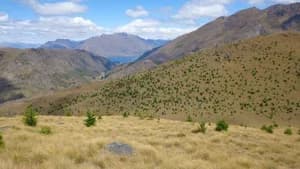
Wilding pines are self-sown conifers growing where nobody planted them. Control options are herbicide, hand releasing with a saw, or mechanical mulching. Mulching takes the tree and processes it into a layer on site, handles stems up to 200mm to 300mm and works slopes to 55 degrees, so it suits the steep, mixed country wildings favour. The single biggest factor in cost is how long the stand has been left, so the right time to act is earlier than most people think.
How to tell a wilding from a planted tree
Wildings are conifers, most often contorta, radiata, Douglas fir or larch, growing scattered and irregular rather than in rows. They turn up downwind of a shelterbelt, a woodlot or a plantation edge, and they colonise tussock, scrub, retired pasture and steep faces that are not actively grazed. If the trees are in a pattern, someone planted them. If they are dotted about with no logic, they are wildings.
The tell that matters for cost is size. A stand of knee-high seedlings and a stand of six-metre trees with real trunks are the same species and completely different jobs.
Why they are a problem and why timing is everything
Wilding conifers convert open country into closed canopy. They take out grazing, dry out catchments, shade out native regeneration, and once the canopy closes the change is expensive to reverse. Each year a stand is left it grows, and it gets closer to producing its own seed and starting the cycle again somewhere downwind.
The economics are brutally simple. A seedling is a moment's work. A ten-year-old tree needs felling, and a hillside of them is a forestry operation. The cost curve is not linear, it is a cliff, and the cliff is somewhere around the point where the stems get thicker than a machine can take.
Herbicide and hand releasing
Chemical control of conifers is slow, expensive at scale, and leaves a landscape of standing dead trees that carry fire risk and still have to come down eventually. Boom spraying is rarely appropriate on the mixed, steep country wildings occupy. Basal and drill-and-fill methods work on individual trees and are labour intensive.
Hand releasing with a saw is effective on seedlings and small trees, and it is limited by how much ground a crew can physically cover in a day and by the terrain. On a steep face of scattered wildings a crew covers less than it would like, and the cut material stays where it falls.
GRazer does not spray. Where a programme genuinely needs chemical follow-up on individual survivors, that is a job for someone else and we will say so.
Mechanical mulching of a wilding stand
A remote-controlled mulcher takes the tree at ground level and processes trunk, branches and needles into a layer that stays on site. Nothing is felled and left, nothing is burned, nothing is carted out. GRazer's machines handle material in the 200mm to 300mm range, which covers a substantial wilding, and they work slopes up to 55 degrees with the operator on stable ground, so the faces where wildings do their best work are inside scope.
Above about 300mm the honest answer changes. That becomes a felling operation with mulching to follow, a different scope and a different cost, and it is the reason to act before the stand gets there.
On open, accessible ground the heavy-duty machine covers typically 2 to 3 acres a day. Scattered wildings across a hillside are slower than a dense stand, because the machine is travelling between trees rather than working a face.
Wildings are a programme, not a job
Seed keeps arriving from any source still standing nearby, so a cleared block will get new seedlings. That is not a failure of the clearing, it is the nature of the species. The cleared block is now open, visible and easy to walk, which means the new seedlings are easy to find and cheap to deal with.
A block that is checked every couple of seasons stays clear for very little. The expensive version is the one where the check is skipped for a decade and the whole exercise starts again from the cliff.
The short version
- Wildings are scattered, irregular conifers where nobody planted them.
- The cost of control is set almost entirely by how long the stand has been left.
- Spraying leaves dead trees standing. Hand releasing does not scale on steep ground.
- Mulching takes the whole tree into a layer on site, up to 200mm to 300mm, on slopes to 55 degrees.
- Check a cleared block every couple of seasons. Seedlings are cheap, trees are not.
Got a site like this?
Call Dan on 027 234 5962, or send the address and a few photos and we will come back to you with an estimate.