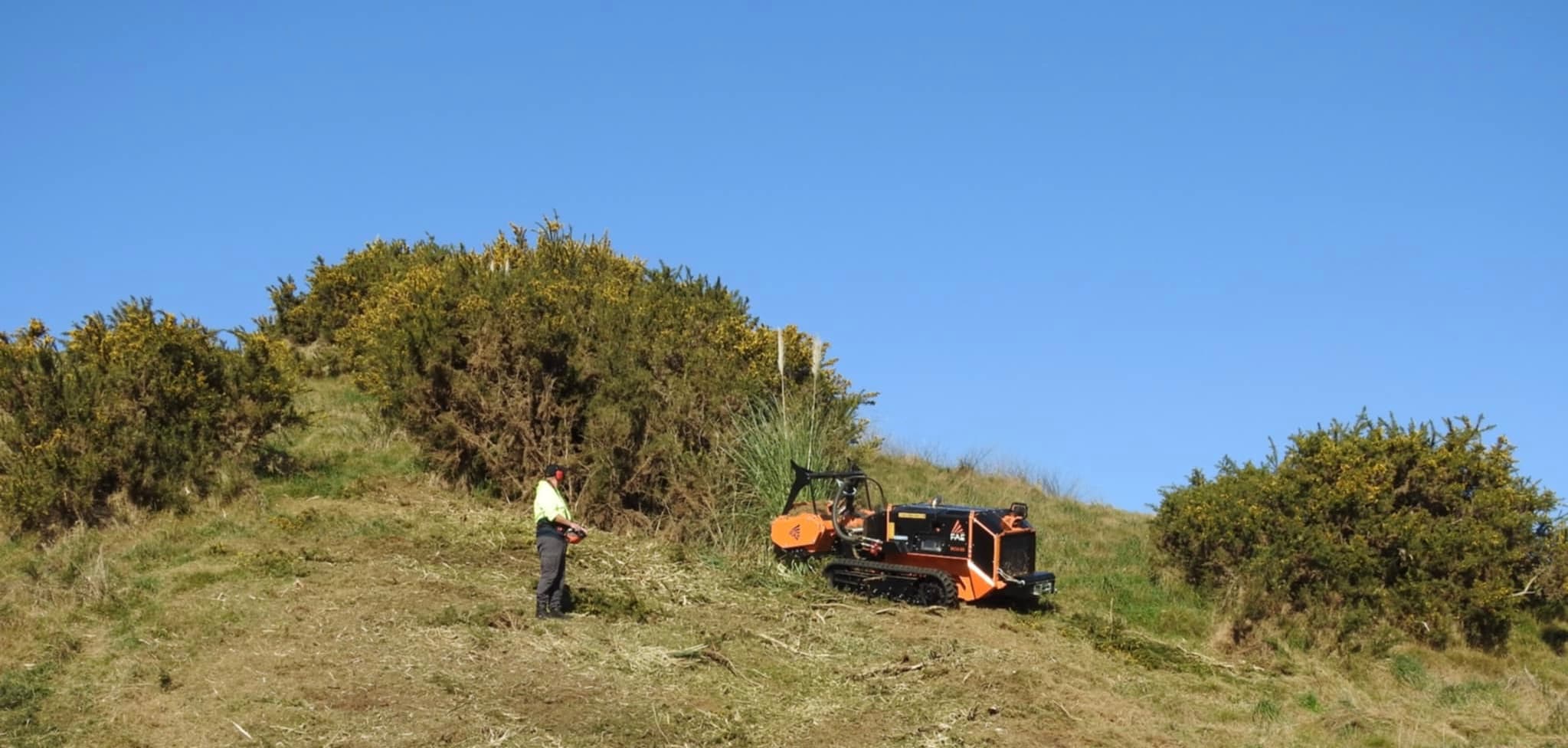
Gorse on a steep slope is controlled one of three ways: spray it and leave it standing, cut it by hand from the face, or mulch it mechanically with a remote-controlled machine while the operator stands on stable ground. On slopes past about 25 degrees, mulching is the only option that removes the plant without putting a person on the hill. None of the three touch the seed bank, so follow-up is always part of the plan.
Why gorse ends up on the steep bits
Gorse is not particularly fussy about slope. It ends up on steep faces because that is the ground nobody manages. The flat gets grazed, topped or sprayed on a schedule. The bank behind the woolshed, the gully, the batter above the road and the face down to the creek get a season ahead, then a year, then a decade. Gorse just fills the gap.
The steepness is also what makes it hard to fix. Every conventional tool for gorse assumes you can stand on or drive over the ground. A tractor and topper is honestly limited to around 20 to 25 degrees. A person with a scrub bar can go steeper, but gorse is spiny, dense and unstable underfoot, and a fall on a gorse face is a serious injury. So the face gets deferred again.
Spraying on a slope: cheap, and it leaves the problem standing
Herbicide is the cheapest gorse control per hectare and it works. What it does not do is remove anything. A sprayed gorse face is a face of dead gorse: drier, more flammable, still impenetrable, and on steep country it can stand for years because nothing is going to knock it down.
There is also the practical question of getting spray onto a steep face at all. Boom spraying is out. Knapsack work on a 40 degree bank of mature gorse is slow, dangerous and patchy. Aerial application has its place on large blocks but is expensive, weather dependent and hard to justify for the face behind a house.
GRazer does not spray. If your situation genuinely calls for it, broad-scale suppression across country you do not need to physically use, we will say so rather than talk you into mulching.
Hand clearing: fine on a small flat patch, not on a face
Cutting gorse by hand gives you precise control and no machinery cost. On a small, accessible area it is a reasonable weekend job. On a slope it is the option most likely to put someone in hospital. The material is spiny, the stems are woody, the footing is loose, and the cut material has to go somewhere, which on a slope usually means dragging it uphill.
It also does not scale. A crew can clear a few hundred square metres of mature gorse in a day. A neglected face is usually measured in hectares.
Mulching: the operator stays on the flat
Remote-controlled mulching is the option built for this exact problem. The machine goes on the face, the operator stands on stable ground with a clear line of sight, and the gorse is taken to ground level and processed into a fine mulch layer that stays on site. Nothing is burned, nothing is sprayed, nothing is carted away.
GRazer's machines are rated to slopes of up to 55 degrees and handle material in the 200mm to 300mm range, which covers mature gorse with real woody stems, the kind that has been left ten years or more. On open, accessible faces the heavy-duty machine covers typically 2 to 3 acres a day.
The result is access. The same day the face is cleared you can walk it, fence it, check it and, most importantly, get stock onto the regrowth. That last point is what makes mulching different from spraying: it turns a gorse face back into a paddock rather than into a dead gorse face.
The seed bank, and what happens next
Be realistic about this. Gorse seed stays viable in soil for decades and an established stand has been dropping it the whole time. No method available removes it. Anyone promising permanent eradication in one visit is not describing gorse.
What mulching does is give you the cheapest possible follow-up. Regrowth from seed is soft, short and coming through a mulch layer, and grazing it is the most effective control there is. The face only becomes grazeable once it is cleared, so the order matters: mulch first, then let stock do the maintenance.
Where grazing is not possible, a light second pass a season or two later deals with regrowth at a fraction of the original cost, because everything coming back is small.
The short version
- Past about 25 degrees, mulching is the only method that removes gorse without putting a person on the slope.
- Spraying kills gorse but leaves it standing, and on a steep face it can stand for years.
- Mulched material stays on site as a layer, no burning and no cartage.
- Nothing removes the seed bank. Plan for grazing or a light follow-up pass.
- Mature, woody gorse needs a machine with real material capacity, not a light slope mower.
Got a site like this?
Call Dan on 027 234 5962, or send the address and a few photos and we will come back to you with an estimate.