Manual clearing means a crew with chainsaws, scrub bars and hand tools cutting vegetation and stacking or burning it. Mechanical mulching means a machine taking the vegetation to ground level and processing it into a mulch layer on site in a single pass. Manual wins on very small areas and around things that must not be touched. Mulching wins on everything measured in hectares, anything steep, and any job where the cut material would otherwise need burning or cartage.
What each one actually does
A manual crew cuts. Chainsaws for anything with a trunk, scrub bars for the rest, and then the material has to be dealt with: dragged into piles, burned when conditions allow, chipped if a chipper can get near it, or carted away. The clearing and the disposal are two jobs and the second is often the bigger one.
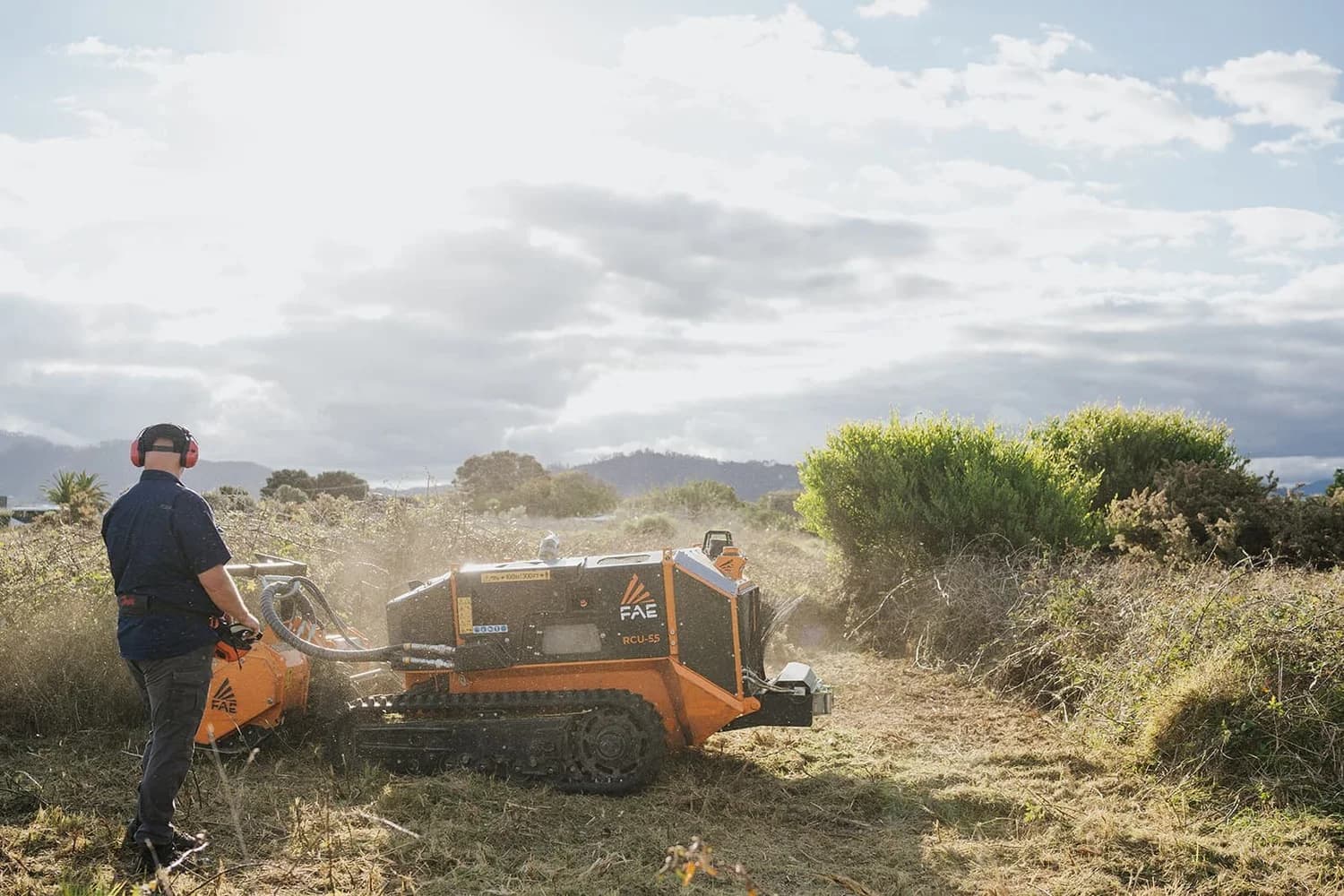
A mulcher does both at once. The head takes the plant at ground level and reduces it to fine chips that fall where the plant stood. There is no pile, no burn day, no green waste bill and no truck. The site is finished when the machine leaves it.
Time
A competent crew of three clears something in the order of a few hundred square metres of dense scrub in a day, then spends more days dealing with what they cut. GRazer's heavy-duty machine covers typically 2 to 3 acres a day on open, accessible ground, disposal included, because there is no disposal.
On a lifestyle block gully or a boundary that has got away, that is the difference between a weekend and a one-day job, and between a fortnight and a week on anything larger.
Safety
Manual clearing puts people in the vegetation with chainsaws, on ground they cannot see, often on a slope. Gorse and blackberry are spiny, footing under scrub is loose, and a slip with a running saw is the kind of accident this industry is built around avoiding.
With remote-controlled mulching nobody is in the vegetation and nobody is on the slope. The operator stands on stable ground with a clear line of sight. On steep faces this is not a marginal safety gain, it is the whole reason the job can be done at all. GRazer's machines work slopes up to 55 degrees, which is far past anything a crew should be cutting on.
Cost
Manual clearing is cheap to start and expensive to finish. The day rate for a crew looks reasonable until you add the days, the disposal, and the second visit because the stumps and regrowth were left. Mulching has a higher day rate and a much lower total on any job of real size, because the day rate covers everything.
The break-even is roughly where the area stops being something you could do yourself in a weekend. Below that, hand clearing can make sense. Above it, the machine is usually cheaper as well as faster, and it gets dramatically cheaper as the site gets steeper, because the manual cost of steep ground climbs faster than the machine cost does.
What is left behind
A manually cleared site has stumps, cut stems, and either a burn scar or bare ground where piles were dragged. Bare ground on a slope erodes. Stumps regrow. The site often looks worse three months later than it did before, because everything comes back from the stump at once.
A mulched site is covered in an even layer of fine chips over the soil, with the old root systems left in the ground holding the slope together. The layer cuts light to the soil and slows regrowth, and it breaks down into the soil rather than being removed. You can walk it the same day.
Where manual clearing genuinely wins
Small areas, tight spots, and anything where selective removal matters. A crew can take one wilding out of a stand of natives, clear around a tree you want to keep, or work a garden margin. A mulcher clears what is in front of it. For restoration work where the surrounding vegetation has value, a compact machine with a careful operator can be very selective, but there are jobs where hands are still the right tool, and a good contractor will say so.
The short version
- Manual clearing is two jobs: cutting, then disposal. Mulching is one.
- Crew: a few hundred square metres a day. Heavy-duty mulcher: typically 2 to 3 acres a day.
- Nobody in the vegetation and nobody on the slope is the safety case for mulching.
- Manual wins on small, selective work. Mulching wins on area, slope and disposal.
- A mulched face is covered and stable. A hand-cleared one has stumps and bare ground.
Got a site like this?
Call Dan on 027 234 5962, or send the address and a few photos and we will come back to you with an estimate.