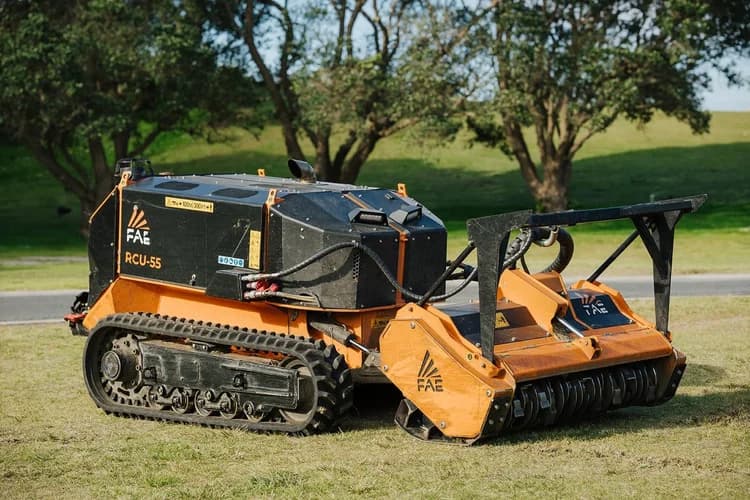
A remote-controlled mulcher is a tracked machine with a mulching head on the front and no cab. The operator controls it from stable ground, so it can work slopes, sensitive terrain and narrow access that a driven machine cannot safely reach. It takes vegetation to ground level and processes it into a mulch layer on site. It is a clearing tool, not a lawnmower, and it is operated by a contractor rather than hired out.
What it is, and what it is not
The machine is a compact tracked carrier, usually diesel, with a hydraulic mulching head at the front. There is no seat. The operator walks the ground nearby, or stands above the slope, with a handheld controller and a clear line of sight.
It is worth separating this from two things it gets confused with. It is not a robot lawnmower, the kind you buy for a suburban section. And it is not a mulching head on an excavator, which is a heavy machine with a cab that has all the slope limits a cab implies. A remote-controlled mulcher sits between the two: the reach and stability of a purpose-built tracked machine, without anyone on it.
Why taking the operator off changes the slope limit
Conventional slope limits exist mostly to protect the person on the machine. Tractor and ATV rollovers remain among the most serious causes of death and injury on New Zealand farms, and the honest safe limit for a tractor and topper is around 20 to 25 degrees, well below what people routinely attempt.
Remove the operator and the binding constraint becomes traction and machine stability rather than whether someone survives a roll. That is how the working limit can be as high as 55 degrees. Fifty-five degrees is a great deal steeper than most people picture, past the point where walking the face is comfortable. Note the unit: degrees, not per cent. Fifty-five per cent is roughly 29 degrees. Fifty-five degrees is nearly twice that, and the two get confused constantly in this industry.
The head: mulching versus flail
The front of the machine takes different attachments, and the attachment decides what the machine is for. A forestry mulching head has fixed or swinging carbide teeth on a heavy rotor and is built to take woody material: mature gorse, tree privet, bamboo, wilding regrowth, small trees. It processes the whole plant into a mulch layer.
A flail head is lighter and built for a clean, even finish on soft growth: rank pasture, kikuyu, long grass on a bank. That is mowing, and mowing is only ever grass. If the job has woody stems in it, it is mulching, whichever machine turns up.
The number that matters on a mulching head is material capacity, the maximum stem thickness the machine will take and process. GRazer's machines handle 200mm to 300mm. The nearest comparable operator in this market advertises 100mm. On a stand that has been left fifteen years, that is the difference between one operation and having to fell everything first.
The two machines in the fleet
Connie is the compact T400. She is the machine for steep banks, sensitive terrain, reserves, waterways and narrow access, and she gets in from 1.4 metres. Lower weight and a smaller footprint mean less ground disturbance on riparian margins and restoration sites. She also carries the flail head, so the tidy finish on soft growth is her job.
The FAE RCU 55 is the heavy-duty machine. It is a mulching machine, full stop, built for scale and stability on commercial, council and civil work, and it takes the heavy material. On open, accessible sites it covers typically 2 to 3 acres a day, depending on density, height, slope and ground.
Between them they cover both ends: the gully behind a house that nothing else fits into, and the roadside batter that needs a day of steady work at angle.
Hiring the machine versus hiring the job
People do search for mulcher hire, and there is a genuine market in dry-hiring tracked mulchers. It is worth knowing what you are taking on. The machine needs transport, an operator who understands how it behaves on a face, insurance, and the judgement to read ground moisture and hidden hazards before committing to a slope. The machines you can readily hire are also generally lighter, with lower material capacity, and the slope rating is only as good as the person on the controller.
GRazer does not hire machines out. We turn up with the machine, the operator, the insurance and the prequalification, do the work, and leave a mulch layer. For most people with a real clearing problem that is the cheaper and safer route, and it is priced by the job rather than by the day.
The short version
- A remote-controlled mulcher is a tracked clearing machine with no cab. The operator stays on stable ground.
- Taking the operator off is what allows a working limit of up to 55 degrees.
- Mulching heads take woody material. Flail heads mow grass. They are different jobs.
- Material capacity decides whether an old stand is one job or three. GRazer handle 200mm to 300mm.
- GRazer operate the machines on your site rather than hiring them out.
Got a site like this?
Call Dan on 027 234 5962, or send the address and a few photos and we will come back to you with an estimate.